

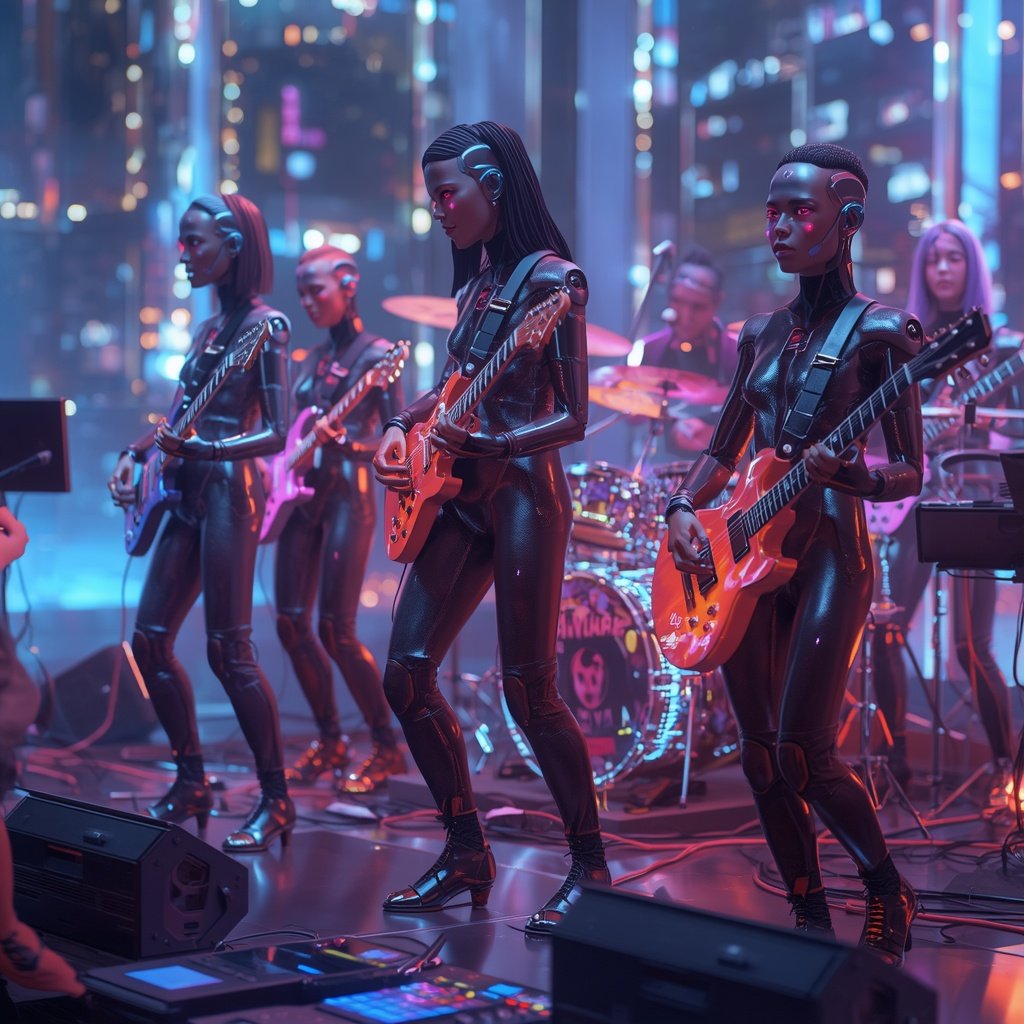
Forget bands.
Forget singers.
Forget the awkward guitarist who insists on doing a seven-minute solo nobody asked for.
AI artists are getting their own music awards.
And they’re apparently going to perform live.
The first AI Music Awards are scheduled to take place in Los Angeles on November 13, with several AI-generated artists expected to appear on stage.
Yes.
An awards show for musicians who don’t technically exist.
Welcome to 2026.
One of the “artists” already made music history
Among the performers is Xania Monet, an AI-generated music act created by songwriter Telisha “Nikki” Jones.
Xania previously became the first AI-generated song to enter a Billboard radio airplay chart with How Was I Supposed To Know.
The project reportedly even became the subject of a label bidding war, with Xania eventually signing a deal reportedly worth around $3 million.
Which creates a rather funny question:
Who gets the backstage pass?
Xania?
Her creator?
The computer?
The person who owns the computer?
Maybe the GPU gets VIP treatment.
Spotify is already preparing for this
The rise of AI artists is happening quickly enough that Spotify has started introducing an “AI Persona” badge for certain artist profiles.
The idea is simple: listeners should know when the artist they’re looking at is an AI-generated identity rather than a traditional human performer.
And honestly, that’s probably going to become increasingly important.
Because imagine finding a new artist you absolutely love.
You follow them.
You stream their album.
You watch interviews.
You become emotionally invested.
Then you discover the “artist” is essentially a very sophisticated pile of algorithms.
That could be quite the relationship crisis.
But here’s where things get interesting
AI music isn’t necessarily going to replace human musicians overnight.
Instead, we’re likely heading toward a strange hybrid world.
Human producers can create AI artists.
Real musicians can use AI voices.
Artists can license digital versions of themselves.
And completely fictional performers can build audiences of their own.
In other words, the definition of “artist” is getting extremely blurry.
Spotify’s decision to label some AI personas is basically an acknowledgment that listeners increasingly need to know what they’re actually listening to.
And now they’re going on stage
That’s the part that really makes this feel like science fiction.
The AI Music Awards will feature creators “directing” the AI artists’ performances.
So technically, the artists won’t be backstage warming up their voices.
Their creators will be.
No vocal warm-ups.
No sore throat.
No missed flight.
No diva demanding that the dressing room be filled with exactly 47 bottles of sparkling water.
Just software.
And a very confused audience.
The technology may be strange, but the business opportunity is obvious.
AI artists can potentially perform endlessly, speak multiple languages and generate music at a scale a traditional artist simply can’t match.
The question is whether audiences will actually care about an artist when there isn’t a human being behind the face.
Because music has always been more than sound.
It’s personality.
It’s emotion.
It’s identity.
And now AI is trying to manufacture all three.
The next big music star might not need a record deal.
They might not even need a pulse.





Laat een reactie achter