

September 25, 2026
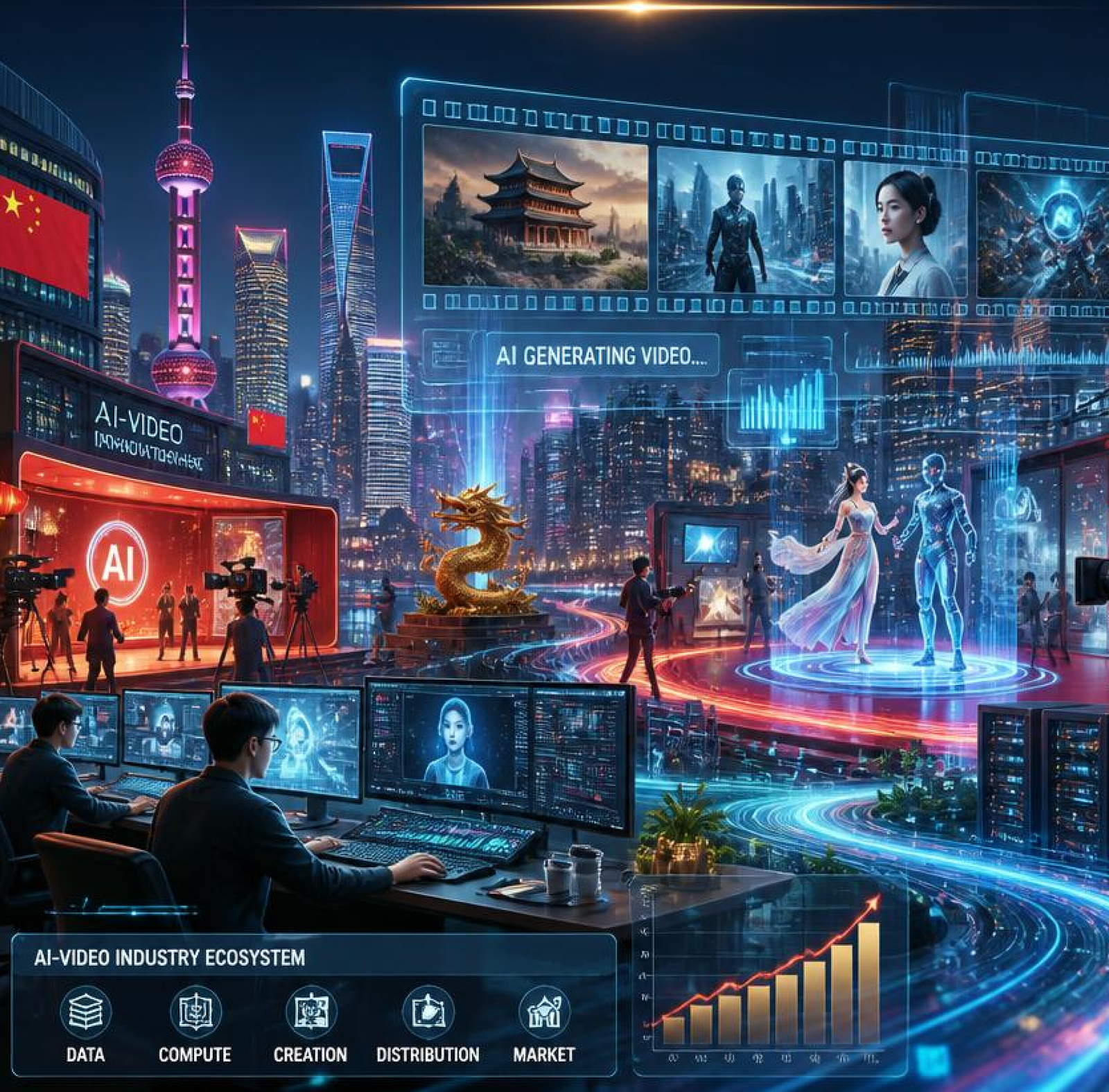
China’s artificial intelligence industry is moving beyond the race to build larger language models and into a different phase of the AI economy: using generative models to create commercial video at industrial scale.
Across China, entrepreneurs, media companies and technology firms are increasingly building businesses around AI-generated films, advertising, animation and other forms of visual production. The development is creating a new production ecosystem around models capable of generating increasingly sophisticated video, while also putting pressure on traditional creative industries to adapt.
Reuters reported Friday that China’s AI-video sector is developing rapidly, with entrepreneurs establishing dedicated studios and businesses designed around generative production rather than conventional film-making workflows.
The shift matters because video is one of the most computationally demanding and commercially valuable applications of generative AI. Unlike text generation, which can often be delivered through relatively lightweight interfaces, high-quality video generation requires substantial computing power, storage, networking and increasingly sophisticated models.
China is now attempting to turn those capabilities into an industry.
From AI experiments to production pipelines
The first wave of generative AI video was largely experimental. Users generated short clips, advertising concepts, cinematic scenes or social-media content from text prompts.
That model is changing.
The emerging Chinese ecosystem is increasingly treating AI video as a production process. Instead of using AI as a single tool inside a traditional workflow, companies are building studios in which large portions of production can be generated, modified and assembled through AI systems.
That changes the economics of content creation.
A conventional production can require actors, cameras, locations, lighting, editing, visual effects and extensive post-production. Generative AI does not eliminate all of those requirements, but it can reduce the amount of physical production needed for certain types of content.
For advertising agencies, game studios and entertainment companies, the attraction is obvious: more variations can be produced more quickly, and visual concepts can be tested before large amounts of money are committed.
China’s large domestic consumer market gives those companies an additional advantage. A successful AI-video production ecosystem does not necessarily need to depend on Hollywood or Western distribution networks to find an audience.
A new battleground for Chinese AI
The development also fits into China’s broader strategy of building an AI technology stack domestically.
Chinese technology companies are competing not only on foundation models but also on chips, cloud infrastructure, data centers and AI applications.
Alibaba, for example, recently announced plans for an AI model with between 5 trillion and 10 trillion parameters while simultaneously introducing a new AI accelerator. The company has also outlined an enormous expansion of data-center capacity.
AI video benefits directly from that infrastructure race.
The more computing capacity becomes available, the more ambitious video-generation systems can become. Larger models can process longer sequences, higher resolutions and more complex interactions between characters and environments.
That creates a feedback loop: better infrastructure enables better models, while commercially successful applications create additional demand for infrastructure.
The economic implications
The significance of AI video extends beyond entertainment.
Advertising could become one of the first industries where the technology produces measurable changes in production economics. A company could potentially create hundreds of localized advertisements, product demonstrations or campaign variations without producing each one traditionally.
The same applies to education, corporate communications, gaming and e-commerce.
An online retailer, for example, could theoretically generate product videos tailored to different languages, markets and customer segments. A game studio could generate environmental assets or cinematic sequences at a fraction of the traditional production effort.
The technology therefore has the potential to become less of a creative novelty and more of a production layer.
That distinction is important.
When AI becomes embedded in production systems, the competitive question is no longer simply which company has the best model. It becomes which companies can integrate models into efficient workflows, control distribution and build a sustainable commercial operation around them.
China’s advantage — and its constraints
China’s enormous technology and consumer ecosystem gives it significant room to experiment with these models.
But the country’s AI-video industry also faces constraints.
AI-generated media raises questions about copyright, likeness rights, misinformation and the ownership of training data. Governments and platforms will have to determine how generated material should be identified and what responsibilities companies have when synthetic content is distributed at scale.
There is also a quality problem.
Generating an impressive five-second clip is very different from generating a coherent feature-length production. Characters must remain consistent, environments must behave logically and stories must maintain continuity over long periods.
Those technical problems are improving, but they remain central to the industry’s development.
The bigger picture
China’s AI-video push illustrates a broader change taking place across artificial intelligence.
The first phase of the AI boom was dominated by foundation models.
The next phase is increasingly about industrialization.
AI is moving into advertising, software development, customer service, robotics, finance, entertainment and manufacturing. The companies that capture value may increasingly be those that turn models into repeatable production systems rather than those that simply demonstrate impressive model capabilities.
China’s rapid development of AI-generated video is therefore not merely a story about filmmaking.
It is another indication that the global AI race is moving from model development toward the much larger question of how artificial intelligence will be integrated into real economies.






Laat een reactie achter