

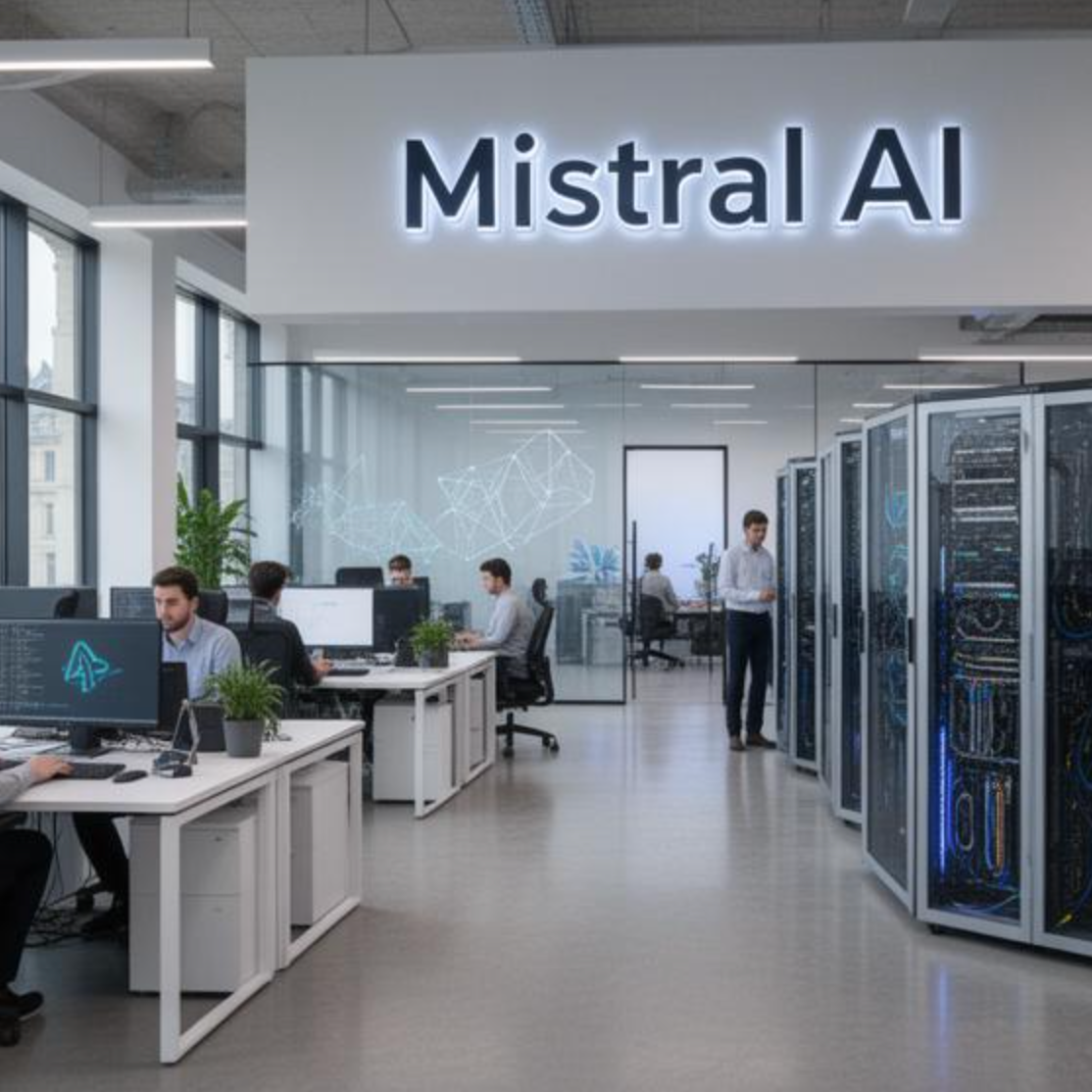
French company Mistral AI has become one of Europe’s most prominent challengers in the AI market. Its latest Large 4 release is particularly relevant because of its stated focus on cybersecurity and its availability for deployment outside a conventional hosted AI service.
According to Reuters, Mistral presented the public release as an improvement on the model introduced several weeks earlier following testing with government and corporate users. The company says the model is designed to help organisations identify security weaknesses and support the process of fixing them. Reuters also reported that Mistral describes it as its most capable openly available model for cybersecurity. These are company claims, rather than independent proof that the model outperforms every competing system. Reuters
Why running AI locally matters
Many businesses access advanced AI through cloud platforms. That approach can be convenient: the provider manages the infrastructure, updates the model and handles much of the technical complexity. However, it can also create concerns about sensitive data, external dependencies, service availability and the degree of control an organisation retains.
A model that can be downloaded and run on an organisation’s own systems offers a different option. Subject to the hardware, licensing terms and deployment requirements, a company may be able to integrate AI more directly into its existing security environment.
For cybersecurity teams, possible applications include:
- Analysing source code for potential security weaknesses.
- Helping engineers understand and prioritise vulnerabilities.
- Assisting with the investigation of suspicious activity.
- Supporting security analysts who need to interpret large volumes of technical information.
- Helping developers assess and repair software problems more quickly.
These are potential uses of AI-assisted security tools, not a guarantee that Large 4 performs every task autonomously or accurately. Human review remains important, especially where an incorrect conclusion could expose a system to attack.
The open-weight debate
Mistral’s release also highlights a central debate in the AI industry: how much access should developers provide to powerful models?
With an open-weight model, users can obtain the model weights and operate the model themselves, subject to the applicable licence. This is different from fully open-source software in the broadest sense: releasing weights does not necessarily mean that all training data, training code and development processes are publicly available.
The advantages can include greater control, more opportunities for customisation and less dependence on a single hosted service. But wider availability can also make it harder for the developer to control who uses the model or what they do with it after release.
That trade-off is particularly significant in cybersecurity. Defensive teams can use advanced AI to find and fix weaknesses, but malicious actors may also try to use AI to discover vulnerabilities or accelerate attacks. A model’s real-world safety therefore depends on more than its release format: its capabilities, safeguards, access conditions and the way it is deployed all matter.
What this means for Europe: Mistral is demonstrating one route to a European AI business: build competitive models, give organisations meaningful deployment choices and target practical business needs. Whether that approach can scale internationally will depend on model quality, reliability, price, computing requirements and sustained investment.
Source: Reuters — Mistral AI publicly releases Large 4, targets cybersecurity users















Laat een reactie achter