

September 30, 2026
For years, artificial intelligence was primarily associated with screens: chatbots, search engines, coding assistants and image generators.
That is changing rapidly.
A new generation of European AI companies is moving artificial intelligence directly into factories, where machines are expected not merely to execute instructions but to understand what is happening around them and adapt in real time.
One of the latest examples is French startup Inbolt, which has raised €11 million to expand its industrial robotics technology into the United States and Asia-Pacific while entering new markets including data centres and electronics manufacturing.
The company’s technology combines 3D vision with AI software designed to allow industrial robots to perceive their surroundings and adjust their actions when conditions change.
It represents a broader shift toward what is increasingly being called physical AI.
Industrial robots have a surprisingly old problem
Modern factories are highly automated, but many industrial robots remain remarkably rigid.
A conventional robot can perform the same movement thousands of times with extraordinary precision. But that precision depends on the environment remaining predictable.
Move a component slightly.
Change the position of a tool.
Introduce a small variation in a part.
Allow equipment to wear.
Suddenly, the robot may no longer know what to do.
Inbolt argues that this is one of the fundamental limitations of traditional industrial automation. Its technology is designed to give robots a form of real-time visual perception, allowing them to detect changes and adapt their behaviour.
That could have major consequences for manufacturing.
From programmed robots to adaptive machines
The difference between traditional automation and AI-driven robotics is subtle but profound.
A conventional industrial robot essentially follows a predetermined sequence.
AI-powered systems can instead attempt to understand the current state of the environment before deciding what action to take.
This does not mean that a factory robot suddenly becomes a general-purpose humanoid capable of reasoning about anything.
Instead, AI is being applied to specific industrial problems where perception and adaptation are valuable.
A robot assembling a component could potentially recognise that a part is slightly misaligned.
A machine inspecting a product could detect a variation that was not explicitly programmed into its original rules.
A robotic system working with different components could adjust its movements without requiring engineers to completely reprogram the production line.
That flexibility is particularly important as manufacturers attempt to produce more product variations without sacrificing efficiency.
Why the technology matters to Europe
Europe has a particularly strong reason to invest in industrial AI.
The continent has a large manufacturing sector, but many European economies also face high labour costs, ageing workforces and growing competition from the United States and Asia.
AI-powered automation offers one possible response.
Instead of simply replacing a human worker with a faster machine, companies are increasingly attempting to build production systems that can operate with less manual intervention while remaining flexible.
That distinction matters.
The next generation of factories is unlikely to consist entirely of identical robots repeating identical tasks. The more interesting possibility is a factory in which machines can continuously interpret their environment and adapt their behaviour.
Inbolt’s expansion signals something bigger
Inbolt was founded in Paris in 2019 and says its AI technology is designed to work across different robot manufacturers rather than being tied to a single hardware platform. The company has now raised €30 million in total funding following its latest €11 million round.
The new capital will be used for international expansion and to enter additional industrial sectors.
The company’s strategy reflects a wider trend in robotics.
Rather than competing primarily by manufacturing another robot arm, startups are increasingly trying to build the intelligence layer that can sit on top of existing industrial equipment.
That could be strategically important.
Factories around the world already contain millions of robots. Replacing all of that hardware would be enormously expensive.
Software that can make existing machinery more capable could therefore have a much faster route into the market.
The rise of physical AI
The term physical AI covers a growing collection of technologies.
It includes autonomous vehicles, warehouse robots, drones, industrial machines and eventually humanoid robots.
What connects them is that the AI system is no longer operating exclusively in a digital environment.
It must perceive the physical world, understand changing conditions and produce actions that have real consequences.
That creates a much harder engineering problem than generating text.
A chatbot can produce an imperfect sentence and immediately try again.
A factory robot that makes a wrong movement can damage a component, stop a production line or injure someone.
Consequently, industrial AI needs much tighter integration between perception, software, hardware and safety systems.
Europe is building an ecosystem around it
The Inbolt funding comes at a time when European investment in robotics and AI is accelerating.
Tech.eu’s latest European funding review found that robotics attracted more than €500 million in funding across deals tracked during the previous week alone, while AI attracted more than €400 million.
Other European companies are attacking different parts of the same problem.
Finland’s Hyperion Robotics, for example, is using computational design, robotic manufacturing and advanced materials to produce lower-carbon infrastructure components. The company says its approach can reduce material use and emissions while increasing production speed.
Together, these developments point toward a broader industrial transformation.
AI is moving from the office into the physical economy.
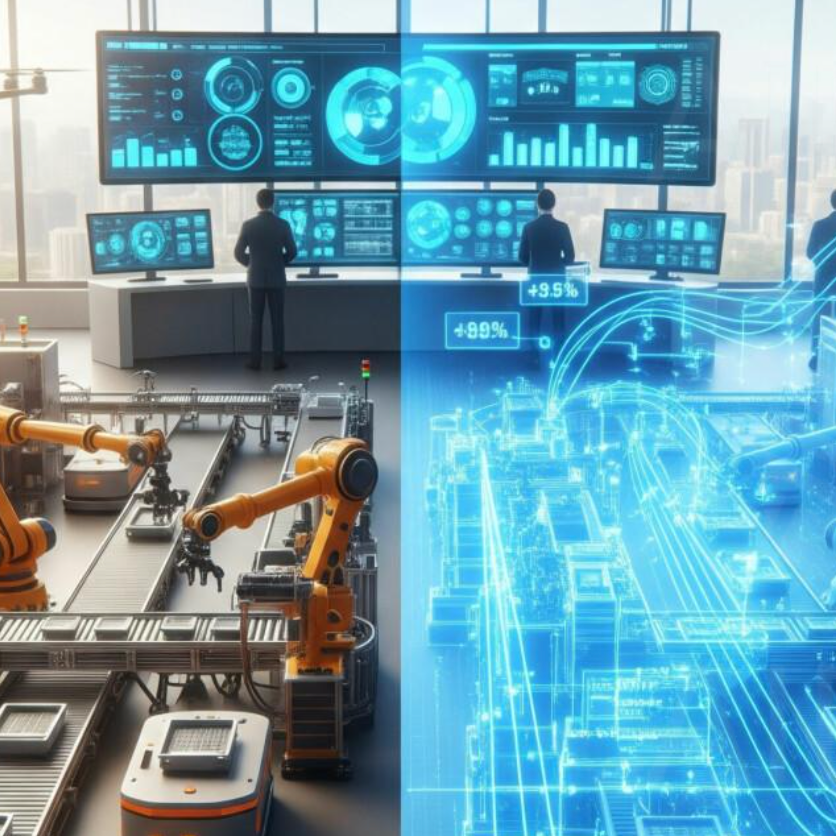
The factory becomes an AI system
The ultimate change may not be a single intelligent robot.
It could be the factory itself.
Sensors collect information.
AI models interpret it.
Robots act on the information.
Production systems respond to changes.
Software continuously optimises operations.
And humans increasingly supervise the entire system rather than manually controlling every individual process.
That is a very different model of manufacturing from the automation revolution of previous decades.
The immediate challenge is reliability.
Manufacturers cannot afford AI systems that work brilliantly 95% of the time if the remaining 5% can cause expensive failures.
But if physical AI can reach the level of reliability required by industrial environments, the consequences could be enormous.
The most important AI systems of the next decade may therefore not live inside smartphones or laptops.
Some of them may be sitting quietly on factory floors, controlling machines that most consumers never see.
Why it matters: Europe is increasingly building AI systems for the physical economy — manufacturing, infrastructure and robotics. The competitive advantage may come not from creating another chatbot, but from making existing machines capable of seeing, adapting and acting intelligently.







Laat een reactie achter