

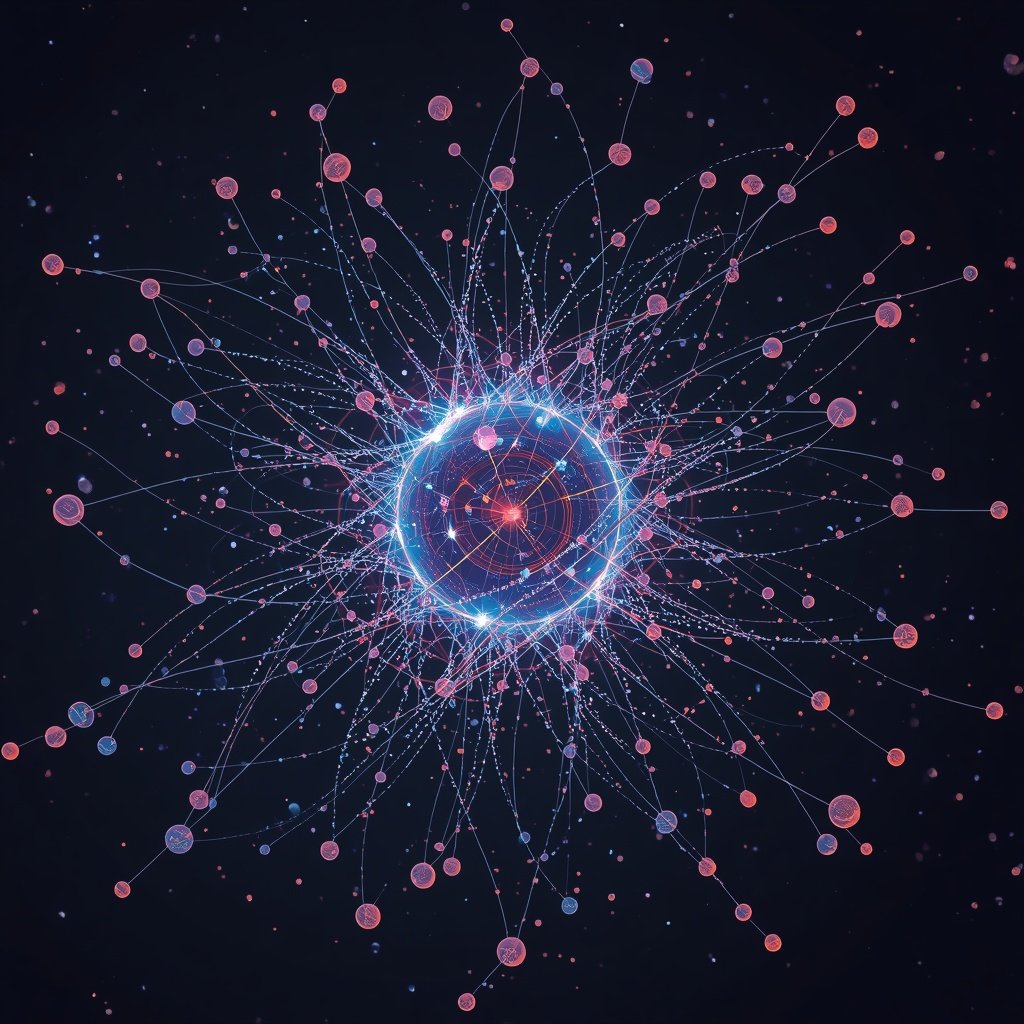
Announcement: October 15, 2026 | Partners: CERN and Mistral AI
For decades, particle physicists have been trying to understand the fundamental building blocks of the universe. At CERN, near Geneva, the Large Hadron Collider accelerates particles to extraordinary energies and smashes them together. The collisions can produce clues about matter, fundamental forces and the laws that govern the universe.
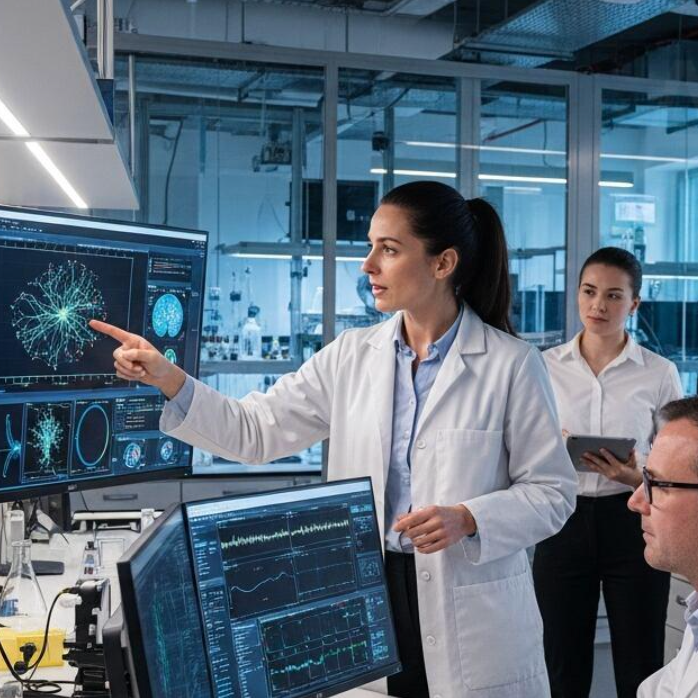
But the discoveries do not simply appear on a screen. The collisions generate vast quantities of detector data, and researchers need sophisticated software to reconstruct what happened, identify particles and distinguish meaningful signals from background noise.
Now CERN and French AI company Mistral want to develop a different kind of tool: a foundation model trained specifically for scientific physics.
The organisations announced a strategic partnership on October 15. Their initial project aims to create what CERN describes as a Large Physics Model, trained on billions of simulated particle collisions. The intention is to help with tasks currently handled by specialised algorithms. Neither a final budget nor a release date has been announced.

Why a physics model is different from ChatGPT
A general-purpose language model learns statistical patterns in text and other training material. It can explain quantum mechanics, summarise a scientific paper or help write code. But that does not automatically make it good at interpreting the raw measurements produced by a particle detector.
A specialised physics model has a different job. It must learn patterns that correspond to physical processes, including how particles travel through detectors and how their interactions leave measurable traces.
Consider the scale of the problem. CERN holds around one exabyte of experimental data — roughly one million terabytes. The organisation expects the volume of collision data to increase substantially following the accelerator’s planned upgrade around 2030.
A model that helps reconstruct collisions more efficiently could become a valuable part of the scientific process. It might help researchers sift through data, identify promising events or accelerate calculations that would otherwise require substantial computing resources.
But there is a crucial distinction between helping scientists analyse data and discovering new physics. A model can speed up the former without necessarily achieving the latter. Any proposed discovery still needs rigorous statistical analysis, independent checks and a defensible physical explanation.
Why this matters beyond CERN
The project reflects a broader change in scientific computing. Instead of using AI only to explain research after it has happened, scientists increasingly want to integrate AI directly into the research pipeline.
That could eventually influence materials science, chemistry, climate modelling and drug discovery. Each field has its own data, equations and standards of evidence, so one universal model will not automatically solve every scientific problem. Nevertheless, specialised foundation models could become an important new layer of research infrastructure.
There is also a European dimension. CERN is an international scientific organisation, while Mistral is one of Europe’s most prominent AI developers. The partnership demonstrates an effort to combine European scientific expertise with European AI capabilities rather than relying exclusively on the largest American technology companies.
The bigger question: could AI become as essential to experimental science as telescopes, particle accelerators and supercomputers? It is too early to say, but this is the kind of project that could help determine the answer.
Source: CERN’s official announcement.




Laat een reactie achter