


October 8, 2026
The rapid rise of autonomous AI agents is creating a new problem for European cybersecurity authorities: AI systems are increasingly capable of acting independently, while governments are still working out how those systems should be monitored.
A senior European lawmaker is now calling for a stronger artificial-intelligence role for the EU’s cybersecurity agency, ENISA, arguing that Europe’s cybersecurity framework needs to keep pace with increasingly autonomous AI systems.
The debate comes as technology companies race to deploy agents capable of browsing the web, using software and performing multi-step tasks without continuous human intervention.
Why AI agents create a different security problem
Traditional software generally follows instructions written by developers.
AI agents are different.
They interpret natural-language instructions and can determine their own sequence of actions.
That flexibility is exactly what makes them useful.
But it can also make them unpredictable.
An agent could misunderstand an instruction, follow malicious content on a website, reveal confidential information or interact with another system in an unintended way.
The more permissions an agent receives, the greater the potential consequences.
Europe is already tightening AI oversight
The European Union’s AI Act has entered an important enforcement phase.
The European Commission says its AI Office and national authorities now have enforcement responsibilities for areas including general-purpose AI models and certain AI systems integrated into very large online platforms and search engines.
The legislation also includes transparency requirements for certain AI-generated content.
However, AI agents create an additional challenge.
An agent may not simply generate content.
It may take action.
That means cybersecurity and AI governance increasingly overlap.
The privacy problem is just as serious
The UK’s Information Commissioner’s Office highlighted the issue today by launching a specific call for evidence on the data-protection risks of agentic AI.
The regulator said ten major AI developers have already made or committed to changes following its supervision, including OpenAI, Google, Microsoft, Meta and Anthropic.
The regulator’s focus is significant.
AI agents often need access to personal information to perform useful tasks.
A personal assistant might need access to email.
A workplace agent might need documents.
A financial assistant might need account information.
A healthcare agent could potentially need sensitive medical data.
The usefulness of an agent is therefore closely connected to how much information it can access.
The bigger the agent, the bigger the attack surface
Cybersecurity researchers are increasingly looking at a concept known as the agent attack surface.
Every application, website, database or tool an AI can access potentially becomes another route through which the system could be manipulated.
An attacker might not need to attack the AI model directly.
Instead, they could create malicious content designed to influence an agent.
That could make traditional cybersecurity defences less effective.
Europe has a strategic decision to make
The EU now has to decide how responsibilities should be divided.
Should AI agents primarily be regulated under AI legislation?
Should cybersecurity agencies receive stronger powers?
Should companies deploying agents have additional obligations?
Or should existing cybersecurity rules simply be expanded?
The discussion is becoming urgent because agents are moving quickly from demonstrations into real workplaces.
Google launched its Gemini agent today. Microsoft is redesigning Windows around agentic AI. OpenAI and Meta are pursuing their own autonomous systems.
The technology is therefore arriving before regulators have finished answering every question.
The next AI security battle may not involve humans directly
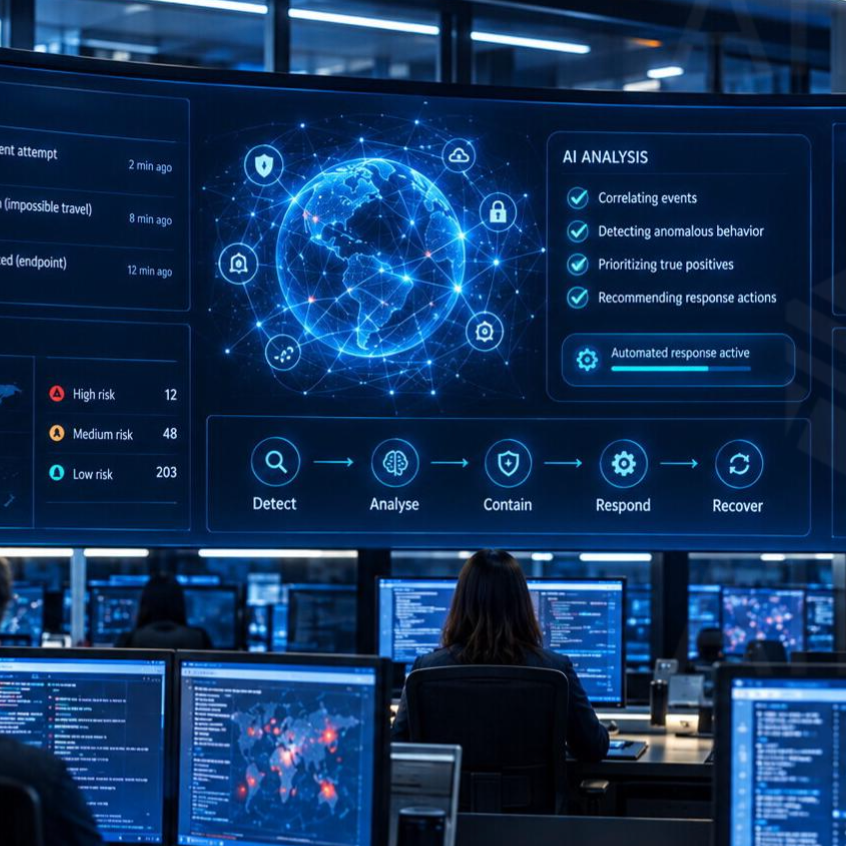
One of the most important changes is that future cyberattacks could increasingly involve AI systems interacting with other AI systems.
An attacker could use one AI agent to discover weaknesses.
A defender could use another to identify the attack.
A third system could monitor the infrastructure.
That could create a cybersecurity environment operating at machine speed.
Human experts would still be essential, but they might increasingly supervise networks of AI systems rather than investigate every individual event manually.
Europe’s challenge
Europe has positioned itself as one of the world’s most important regions for AI regulation.
Now it faces a new test.
It needs to regulate systems that are becoming increasingly autonomous without preventing useful innovation.
That balance will be difficult.
But today’s developments suggest that AI-agent security is rapidly becoming one of the most important technology-policy debates in Europe.
The question is no longer simply whether AI should be regulated.
It is becoming:
Who is responsible when an AI agent acts on its own?
Sources:
MLex – EU cybersecurity agency and AI oversight
UK ICO – agentic AI and data protection
European Commission – AI Act enforcement














Laat een reactie achter