

September 28, 2026
The future of humanoid robotics is usually presented in laboratories.
A robot walks across a stage.
It picks up a box.
It performs a carefully rehearsed task.
Engineers applaud.
Then the robot goes back into the lab.
China is trying something very different.
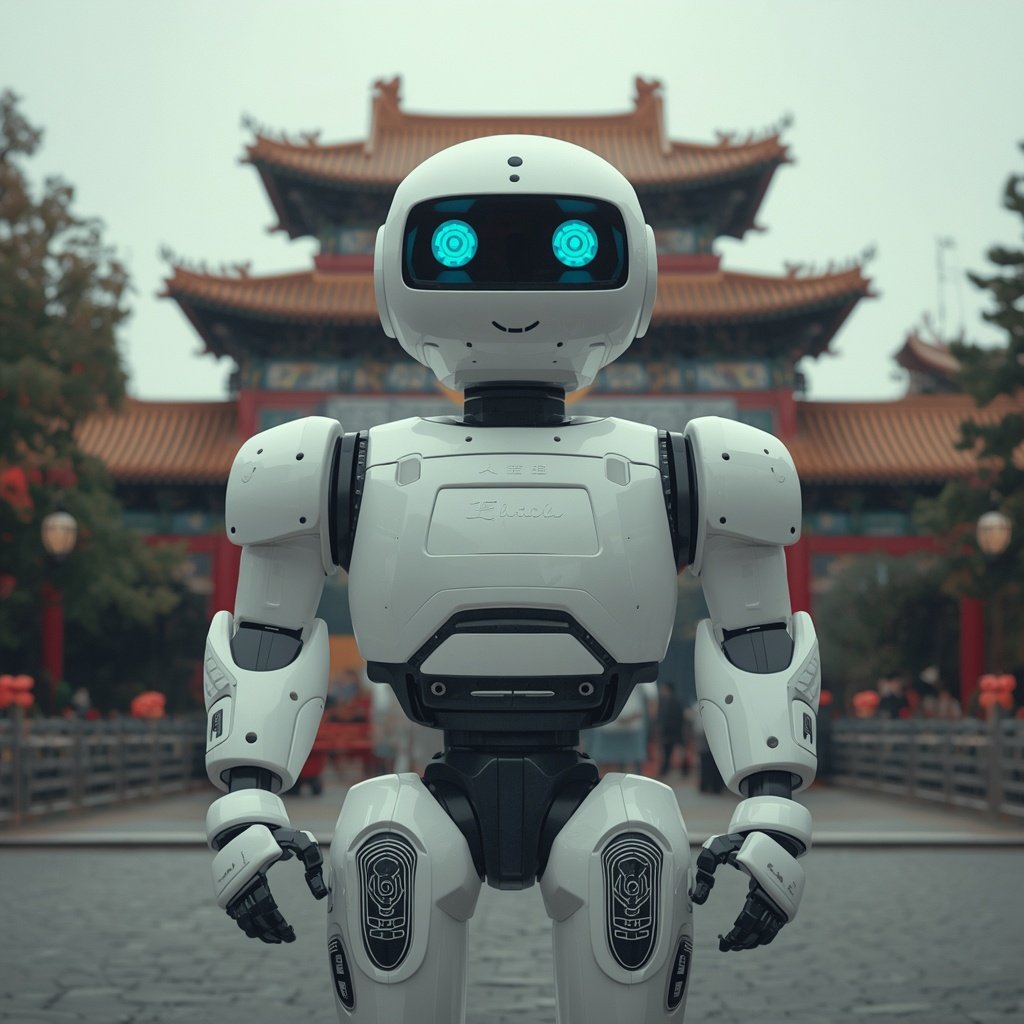
At Chimelong Spaceship Park in Zhuhai’s Hengqin area, more than 300 robots are now operating in a real visitor environment, across entertainment, education, guided tours, retail and other services. AGIBOT says the project represents a large-scale deployment of embodied AI rather than a conventional technology demonstration.
That distinction is important.
Because instead of asking whether robots can perform one impressive trick, the project is asking a much more difficult question:
What happens when hundreds of robots have to work around real people, all day, in a real business?
This is not a laboratory
The scale of the deployment is what makes the project unusual.
According to AGIBOT, more than 300 robots are being used across more than 100 interaction points at the park. The systems are intended for applications spanning visitor services, guided experiences, science education, entertainment and other functions.
China Daily reported that the park has opened as an embodied-AI-focused theme park, with robots integrated into services including entertainment, science education, guided tours and retail.
That means the robots are no longer operating in an environment where every movement can be controlled.
Visitors do not behave predictably.
Children run around.
People stop unexpectedly.
Queues form.
Objects get moved.
Lighting changes.
Noise levels fluctuate.
People ask strange questions.
Someone inevitably walks directly into the robot’s path.
For embodied AI, those mundane situations can be more difficult than a controlled laboratory demonstration.
The real challenge is not walking
Humanoid robotics has spent years focusing on locomotion.
Can the robot walk?
Can it balance?
Can it climb stairs?
Can it recover from a fall?
Those are difficult engineering problems.
But once a robot enters a public environment, walking becomes only one part of the challenge.
It needs to understand where it is.
It needs to identify people and objects.
It needs to understand what a person is asking.
It needs to decide what action to take.
It needs to navigate around unexpected obstacles.
And it needs to do all of this without constantly requiring a human operator.
That is where embodied AI becomes interesting.
The intelligence is not only inside the language model.
It is distributed across perception, planning, control, navigation, manipulation and interaction.
A robot has to turn information into physical action.
Why a theme park is a surprisingly useful test
A theme park may sound like a strange place to test advanced robotics.
In reality, it may be one of the most interesting environments available.
Theme parks contain almost every challenge that service robots eventually need to handle.
There are crowds.
There are repetitive tasks.
There are predictable routes.
There are customers.
There are retail areas.
There are attractions.
There are signs and information points.
There are employees.
There are queues.
And there are large numbers of interactions taking place simultaneously.
The environment is structured enough for robots to operate in, but chaotic enough to expose weaknesses.
That makes it a natural proving ground for embodied AI.
From robot demo to robot workforce
The broader significance is that AGIBOT is treating robots as a deployable workforce rather than individual experimental machines.
That is a major shift in thinking.
A single humanoid robot can be impressive.
But one robot does not fundamentally change an industry.
Hundreds of robots working together could.
The economics of robotics ultimately depend on utilization.
A robot that works for five minutes during a demonstration is a technological achievement.
A robot that operates every day, performs useful work and generates measurable value is a commercial product.
That is why deployments like Chimelong matter.
They provide an opportunity to discover what actually breaks when robotics moves from controlled demonstrations into continuous operation.
The robots will have to deal with failure
There is another reason real-world deployment matters.
Robots fail.
Sensors become confused.
Objects move.
People behave unexpectedly.
Networks disconnect.
Batteries need charging.
Software behaves differently in one location than another.
A robot that performs perfectly in a laboratory can behave very differently when hundreds of people surround it.
The most valuable data may therefore come from failures.
Every unexpected interaction can provide information about how the system should perceive, plan and respond next time.
This creates a feedback loop.
Deploy robots.
Collect real-world data.
Identify failures.
Improve the models.
Update the robots.
Deploy again.
That loop is one of the reasons companies developing physical AI are racing to get machines into real environments.
China’s robotics strategy is becoming increasingly physical
The Chimelong project also reflects a broader movement in China’s robotics industry toward large-scale commercial deployment.
AGIBOT has been developing humanoid systems alongside training platforms and embodied-AI software. Its recent announcements have increasingly focused on real-world applications rather than laboratory demonstrations.
The company says the Chimelong deployment coincides with the delivery of its 20,000th robot from its production line.
That figure needs to be understood in the context of the company’s broader product portfolio and production claims rather than interpreted as 20,000 autonomous humanoids independently working in the world.
But it illustrates the direction of travel.
Robotics companies increasingly want manufacturing scale, data scale and deployment scale at the same time.
Why 300 robots is a different problem from one robot
Imagine operating a single humanoid robot.
If something goes wrong, a technician can intervene.
Now imagine 300.
A fleet creates an entirely different engineering challenge.
You need fleet management.
You need remote diagnostics.
You need battery management.
You need software updates.
You need scheduling.
You need maintenance.
You need safety monitoring.
And you need to understand how robots behave when they share the same environment.
That begins to look less like traditional robotics and more like operating a distributed computing system — except the computers can physically move through your building.
The theme park may become a new kind of AI laboratory
There is a subtle but important consequence of deployments like this.
The most valuable AI training data may increasingly come from places where humans and machines interact naturally.
A robot in a laboratory can be given perfectly labelled tasks.
A robot in a theme park encounters the messy reality of human behavior.
Someone asks an unexpected question.
Someone changes direction.
Someone drops something.
A child points at the robot.
A visitor asks it to dance.
A queue suddenly forms.
A person approaches from behind.
These interactions generate data that is difficult to reproduce synthetically.
And that data can become valuable for improving embodied models.
The next step is not necessarily more humanoids
The most interesting question may be what happens after the novelty wears off.
Once visitors stop taking pictures of the robots, the technology has to prove that it is useful.
Can it reduce staffing pressure?
Can it improve visitor experiences?
Can it operate for long periods without intervention?
Can it handle thousands of interactions?
Can it be maintained economically?
Can the same technology be moved into hotels, airports, hospitals, shopping centers or factories?
Those questions will determine whether the deployment is a spectacle or the beginning of a scalable business model.
A glimpse of what physical AI could look like
For years, AI has lived mostly inside computers.
It writes.
It searches.
It summarizes.
It generates images.
It writes software.
Now a growing part of the industry is attempting to move those capabilities into the physical world.
The Chimelong deployment is one of the clearest examples of that transition.
The important number is not simply 300.
It is the fact that those robots are operating where humans are.
That changes the test completely.
The future of robotics will not ultimately be decided by which machine can perform the most impressive demonstration on a stage.
It will be decided by which systems can survive the messy, unpredictable and repetitive reality of everyday life.
And in Zhuhai, that experiment is already underway.


Laat een reactie achter