

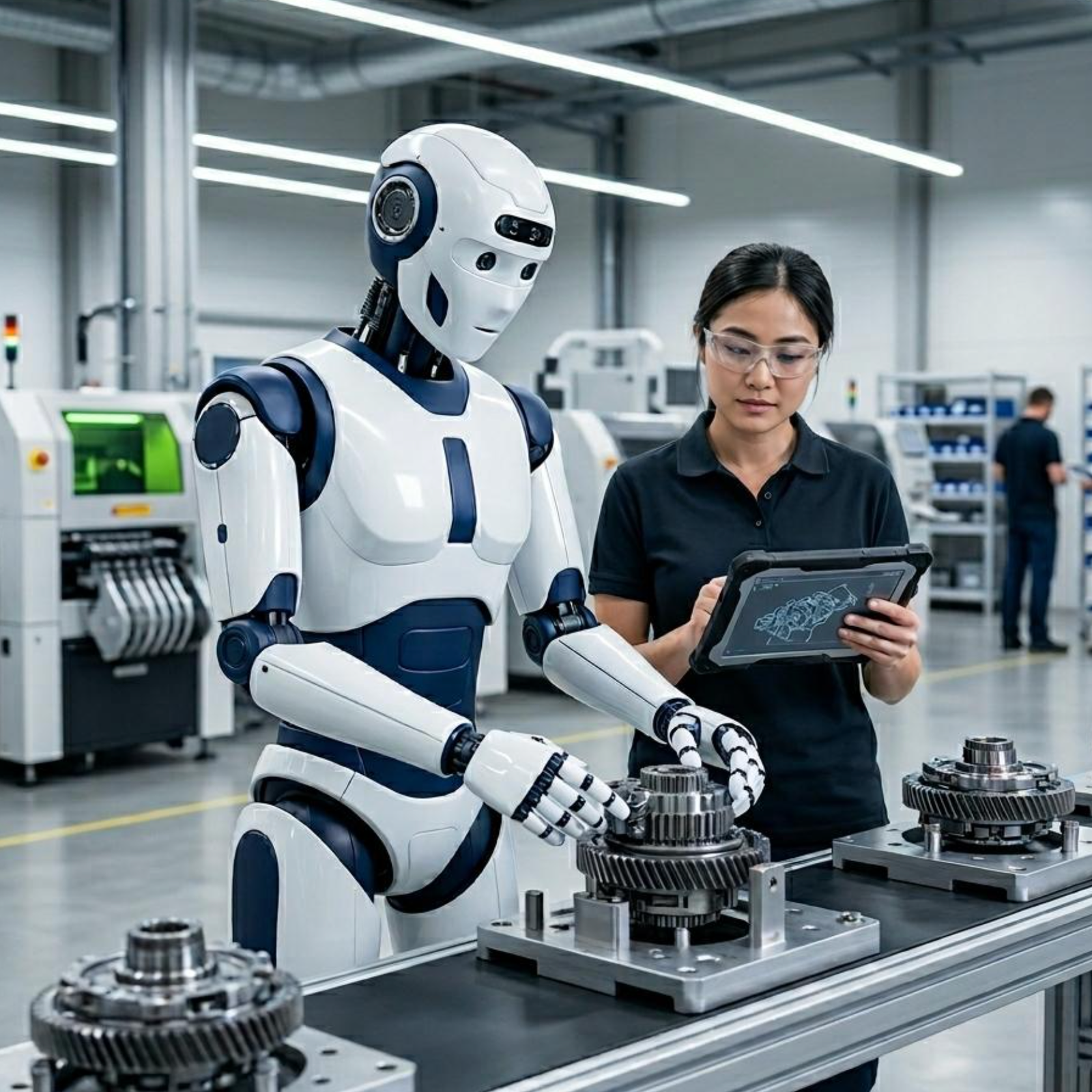
Europe may have a competitive advantage in the next phase of artificial intelligence, not because it leads every category of AI software, but because it has decades of experience building machines, industrial systems and precision-engineered products.
That was the central message from Nvidia chief executive Jensen Huang during the company’s GTC event in Berlin on 21 October 2026. As Nvidia expanded partnerships with European manufacturers and startups, Huang argued that the region’s engineering expertise could make it a major force in physical AI: systems that allow machines and robots to perceive, reason about and interact with the real world.
The message offers a different perspective on Europe’s position in the global AI race. Rather than trying to replicate every aspect of the American and Chinese technology ecosystems, Europe could build on the strengths it already possesses in manufacturing, robotics, automotive engineering and industrial automation.
Whether that opportunity becomes a lasting advantage will depend on how effectively European companies combine those capabilities with advanced AI software and the infrastructure needed to deploy it.
What is physical AI?
Much of the public conversation about AI has focused on systems that generate text, images, audio or computer code. Physical AI extends the concept into machines that operate in real environments.
These systems may combine AI models with cameras, sensors, robotic actuators and simulations. They can be trained to recognise objects, interpret surroundings, plan movements and respond to changing conditions.
Potential applications range from warehouse automation and industrial inspection to agricultural machinery, logistics and certain forms of healthcare assistance.
Unlike a chatbot, a physical AI system must interact with the constraints of the real world. A robot has to understand where objects are, avoid obstacles, manipulate items without damaging them and respond safely when conditions change.
That creates difficult engineering problems. Real-world environments are unpredictable, sensors can produce incomplete information, and physical movements must meet strict requirements for reliability and safety.
AI can improve how robots interpret their surroundings and choose actions, but it must work alongside mechanical engineering, control systems and extensive testing.
Why Europe has a potential advantage
Europe has a long industrial tradition, with expertise in automotive manufacturing, machinery, precision engineering and factory automation.
Germany is home to major industrial manufacturers and automation specialists. France has a substantial aerospace and robotics ecosystem, while countries including Sweden, Italy, the Netherlands and Denmark have strengths in advanced manufacturing, logistics, sensors and industrial technology.
These industries already possess something that AI developers need: experience with the physical processes that robots are expected to perform.
A company building a robot for a factory must understand much more than the AI model. It needs to know how the production line works, how equipment behaves under load, what tolerances are acceptable and what happens when a machine fails.
Europe’s established manufacturers can contribute this expertise, while AI developers supply new capabilities for perception, planning and adaptation.
This creates an opportunity for collaboration between traditional industrial companies and newer AI businesses.
Nvidia wants a role in Europe’s industrial future
Nvidia’s European strategy reflects the growing commercial importance of physical AI.
The company supplies GPUs and software used to train AI models, simulate environments and run AI applications. It has a commercial interest in expanding these technologies into factories, robotics and industrial systems.
At its Berlin event, Huang highlighted partnerships involving European manufacturers and startups. Among the demonstrations were small duck-shaped robots developed by French startup Pollen Robotics in collaboration with Hugging Face.
The demonstration was entertaining, but the broader message was serious: robots that can respond to instructions and interact with their environment could eventually support a wide range of practical applications.
Nvidia also highlighted industrial infrastructure and simulation technologies designed to help companies develop and test AI-enabled systems before deploying them in real facilities.
Such partnerships could help European companies combine their industrial expertise with access to advanced AI computing and software.
However, a demonstration is not the same as a commercially viable product. Robots must still prove that they can perform useful tasks reliably, at an acceptable cost and with appropriate safety controls.
Humanoid robots are attracting attention, but factories may come first
Humanoid robots receive substantial attention because their human-like form suggests that they might eventually work in environments designed for people.
But the commercial case is not limited to humanoid machines. Industrial robots, autonomous mobile systems and specialised robotic equipment may be more practical for many tasks.
Factories already use automated systems for welding, painting, assembly, packaging and inspection. AI could make some of these systems more adaptable, helping them cope with changing products or less predictable conditions.
In logistics, robots may be able to navigate more complex environments or handle a wider range of objects. In agriculture, AI-powered machines could support monitoring, sorting and targeted operations.
The most successful applications will depend on the task. A humanoid robot is not necessarily the best solution for every job, and a specialised machine may deliver better performance at a lower cost.
For European manufacturers, the key question is not whether robots look futuristic. It is whether they can improve productivity, quality, safety or flexibility.
The gap between research and deployment
Europe’s opportunity comes with a significant challenge: turning research and engineering capability into products that can be manufactured and deployed at scale.
Developing a promising robot is only the beginning. Companies must validate reliability, secure suppliers, establish manufacturing processes, train customers and provide ongoing maintenance.
They also need access to funding. Hardware businesses can require substantial capital because they must develop physical products, build prototypes and establish production capacity before reaching large sales volumes.
Software startups can sometimes expand quickly once a product is ready. Robotics companies often face a more demanding path because every unit must be manufactured, tested, delivered and supported.
This is one reason partnerships between established manufacturers, AI developers and investors may be particularly important in Europe.
Large industrial customers can provide real-world testing environments and help identify practical requirements. Established suppliers can contribute manufacturing expertise, while startups can develop specialised AI capabilities.
The role of data and simulation
Training robots in the physical world can be slow, expensive and potentially dangerous. A robot may need to repeat a task many times before it performs consistently.
Simulation offers a way to test systems in virtual environments. Engineers can create digital representations of machines, factory layouts and objects, then evaluate how an AI system responds to different conditions.
These simulations can help developers generate training scenarios that would be difficult or costly to reproduce physically.
However, a robot that performs well in a simulation may still encounter unexpected problems in the real world. Differences in lighting, friction, sensor quality, object shape and environmental conditions can affect performance.
Developers therefore need to combine simulated training with real-world testing and validation.
Europe’s industrial base could help here by providing access to realistic operating environments and the engineering knowledge needed to evaluate results.
What Europe must do to compete
To turn physical AI into a strategic advantage, Europe will need more than demonstrations and pilot projects.
Manufacturers need reliable access to AI computing infrastructure and practical tools for integrating AI into existing systems. Startups need funding that supports hardware development and international expansion. Workers need training that helps them operate, maintain and supervise new technologies.
Regulation will also matter. Robots operating around people or controlling industrial equipment must meet safety requirements, and companies need clear guidance about responsibility when automated systems make mistakes.
At the same time, Europe must avoid making it unnecessarily difficult for promising technologies to move from experimentation to commercial deployment.
The goal should be to combine trustworthy AI with competitive products and a strong manufacturing ecosystem.
Can physical AI become Europe’s defining advantage?
Europe is unlikely to dominate every area of AI simply by building on its industrial strengths. The United States and China also have major manufacturers, research institutions and technology companies.
Nevertheless, physical AI could provide Europe with a distinctive opportunity. The region does not need to win every competition in general-purpose language models to develop globally competitive systems for manufacturing, logistics, mobility and other physical industries.
Its success will depend on whether established industrial expertise can be combined with modern AI models, strong software, sufficient investment and rapid commercial execution.
The bottom line: Europe has an opportunity to make robotics and industrial AI a central part of its technology strategy. Nvidia’s partnerships highlight the potential, but the decisive test will be whether European companies can turn that potential into reliable, affordable products used at scale.
Source: Reuters — Nvidia’s Jensen Huang highlights Europe’s AI potential and robotics partnerships.








Laat een reactie achter