

September 30, 2026
Europe’s autonomous-driving race is entering a new phase, and one of the most significant developments is coming from China.
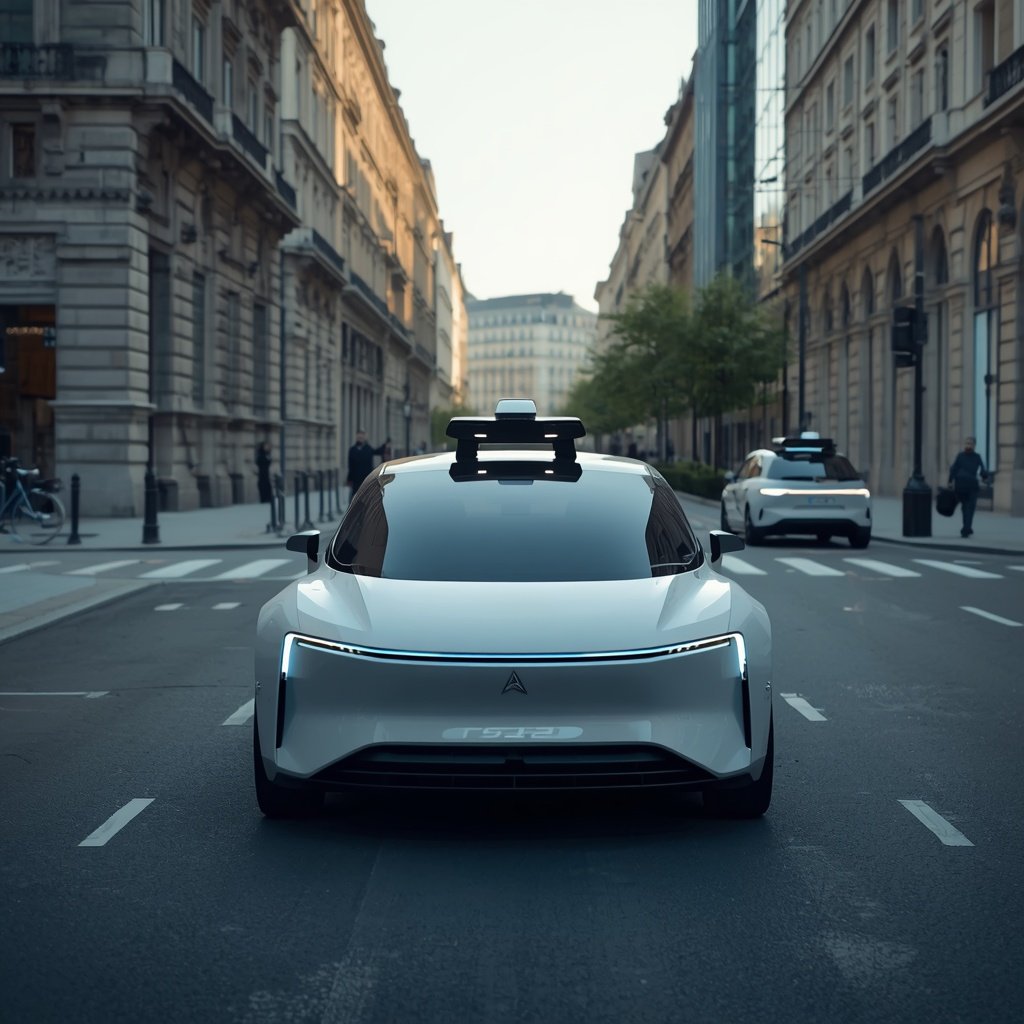
Chinese autonomous-driving company Momenta is preparing to expand its robotaxi operations beyond China, with Dubai and additional European cities now in its sights. The company already has vehicles operating or being tested in China, Munich and Abu Dhabi, and says it wants to scale from more than 100 robotaxis today to hundreds by the end of 2026 and potentially thousands in 2027.
The development is significant because Europe has traditionally moved more cautiously than China and the United States when it comes to fully autonomous passenger transport. Regulatory requirements, safety validation and the complexity of European cities have made large-scale robotaxi deployment difficult.
Momenta’s strategy suggests that this may be changing.
Munich is becoming a European testing ground
Munich has emerged as one of the company’s most important European locations.
Momenta has already received nationwide German approval for Level 4 autonomous-driving testing, allowing it to conduct urban testing across Germany without applying separately for permission in every city. The approval was granted by Germany’s Federal Motor Transport Authority, known as the KBA.
Level 4 autonomy is an important distinction. At this level, a vehicle can operate without a human driver within a defined operational area and under specified conditions. That makes it fundamentally different from today’s advanced driver-assistance systems, where a human remains responsible for the vehicle.
Momenta and Uber had already announced plans to test Level 4 vehicles in Munich during 2026, with the companies describing the German city as a starting point for broader European expansion.
The choice of Munich is hardly accidental.
The city sits at the centre of one of Europe’s most important automotive ecosystems and is home to major manufacturers, suppliers and engineering companies. Testing autonomous systems there exposes them to a combination of dense urban traffic, complex road layouts, cyclists, pedestrians and sophisticated automotive infrastructure.
For an autonomous-driving company, that creates a particularly demanding environment.
From Chinese roads to European streets
Momenta has been developing autonomous-driving technology in China since 2016 and has built a business that combines driver-assistance systems with fully autonomous driving.
The company says its assisted-driving technology is already being used in hundreds of thousands of vehicles, while its robotaxi business is intended to provide a path toward increasingly autonomous transportation.
That dual strategy is important because robotaxis require enormous quantities of real-world driving data.
Every unusual intersection, unexpected pedestrian movement, road obstruction and weather condition can potentially become another piece of information for training and validating autonomous-driving systems.
Momenta describes this as a data-driven development cycle in which increasingly sophisticated algorithms generate more driving experience, which can then be used to improve subsequent versions of the system.
The company’s European expansion therefore isn’t simply about putting Chinese robotaxis onto European streets.
It is also about collecting data and proving that the technology can operate under a different regulatory and environmental framework.
The economics are becoming as important as the technology
There is another problem autonomous-driving companies have to solve: cost.
Running a robotaxi requires significant computing power, sensors, communications infrastructure and vehicle hardware. If every vehicle requires extremely expensive computing hardware, the economics of large fleets become difficult.
Momenta is therefore also working with chip company XHeart on dedicated processors for autonomous driving. The company says it wants future robotaxis to use these chips because they could provide lower costs than equivalent general-purpose computing hardware.
That illustrates an important shift in the autonomous-driving industry.
The technological race is no longer simply about who can build the most capable AI model.
It is increasingly about who can build a complete system cheaply enough to operate millions of kilometres of commercial driving.
Europe is becoming a battleground
Momenta is not the only company looking at Europe.
Other Chinese autonomous-driving companies, American technology companies and European automotive groups are all attempting to establish positions in the region.
For European cities, that creates a complicated situation.
Robotaxis could eventually reduce the cost of urban transportation, increase vehicle utilisation and provide mobility for people who cannot drive. But autonomous vehicles also introduce new questions surrounding safety, data, liability, cybersecurity and infrastructure.
There is also a broader industrial dimension.
The autonomous-driving market increasingly connects artificial intelligence, semiconductors, automotive manufacturing and cloud computing. A successful robotaxi platform could therefore become more than a transportation service. It could become a major technology platform.
The European question
The biggest question is no longer whether autonomous vehicles can drive through European cities.
The question is how quickly regulators, cities and companies will allow them to scale.
Germany’s decision to permit nationwide Level 4 testing removes one important barrier for companies such as Momenta. But testing remains very different from large-scale commercial deployment.
A robotaxi that successfully navigates several hundred kilometres of Munich traffic is not automatically ready to operate across Paris, Amsterdam, London, Milan or Madrid.
Each city introduces different road designs, traffic behaviour, weather conditions and regulatory requirements.
Momenta’s ambition to expand into additional European cities therefore represents a much larger technical challenge than simply increasing the number of vehicles.
If the company succeeds, however, Europe could become one of the world’s most important proving grounds for Chinese autonomous-driving technology.
And Munich may be the first chapter rather than the destination.
Why it matters: The robotaxi race is becoming genuinely global. Chinese companies are no longer concentrating exclusively on domestic deployment, while Europe is gradually becoming an important testing and commercialisation market for autonomous-driving systems.








Laat een reactie achter