

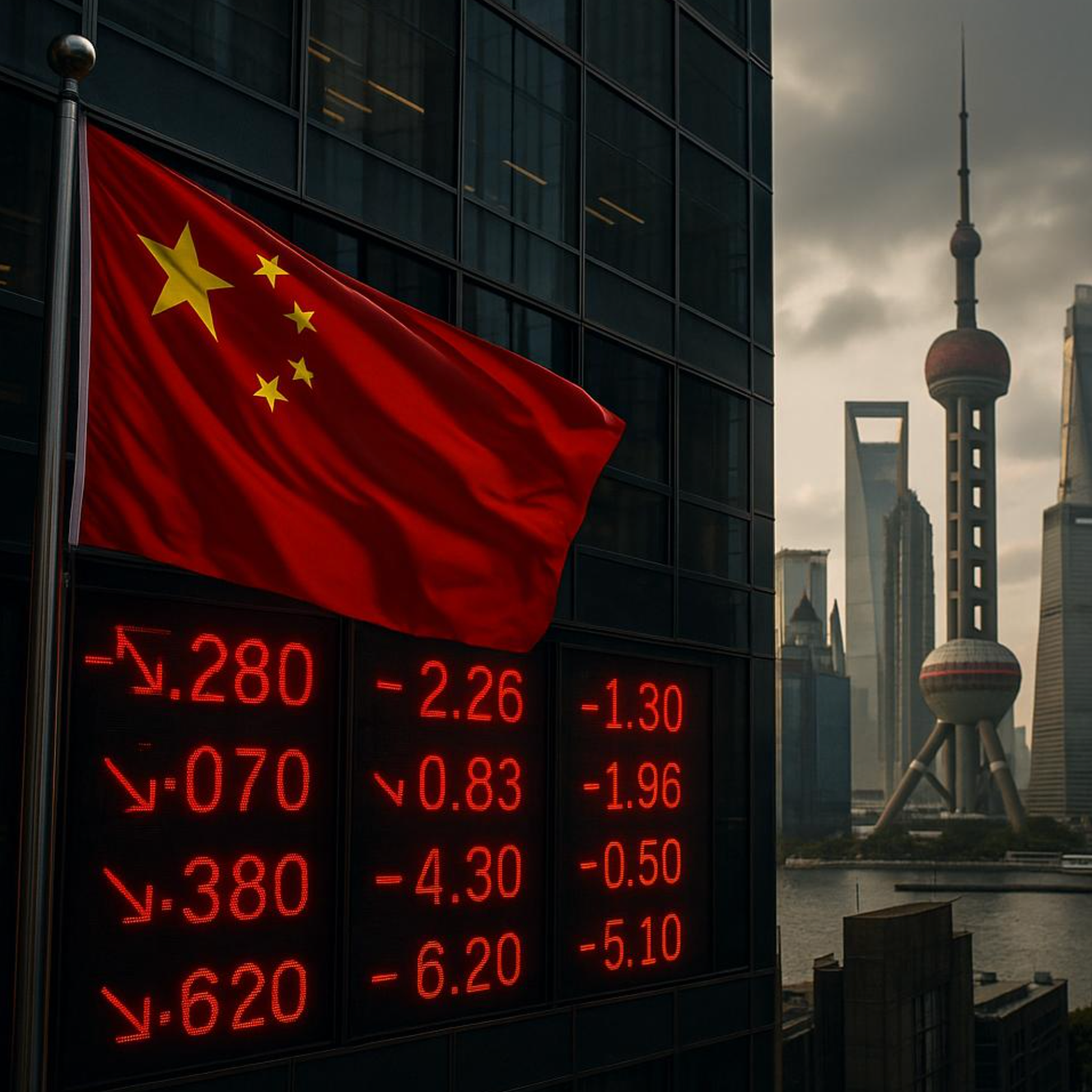
China’s technology markets are confronting a sharp reversal in investor confidence, with AI and semiconductor shares suffering a steep decline as concerns grow over valuations, demand and export restrictions. A Reuters analysis published on 26 October 2026 reported that the mainland STAR 50 index, which includes leading technology and semiconductor companies, had fallen approximately 40% in less than four months.
The sell-off has reportedly erased around $480 billion in market value. It marks a significant setback for a market that had benefited from enthusiasm about artificial intelligence, government support for technology development and expectations of sustained growth in China’s domestic semiconductor industry.
The decline also raises a wider question for global investors: is the AI boom entering a more difficult phase in which financial markets demand stronger evidence that massive investments will produce lasting commercial returns?
From optimism to a sharp correction
AI-related companies have attracted substantial investor attention as governments and businesses race to develop advanced models, computing hardware and applications.
In China, the excitement has been particularly closely connected to ambitions to strengthen domestic technology capabilities. Semiconductor companies and AI developers are viewed as important parts of the country’s long-term economic and strategic plans.
That optimism helped drive a substantial rally in technology shares. But rising valuations can become vulnerable when expectations move ahead of the underlying financial performance of the companies involved.
Investors are now reassessing the outlook amid questions about the strength of AI demand and the impact of restrictions on Chinese technology exports.
A fall of around 40% in the STAR 50 index does not mean that every AI company has lost the same proportion of its value. Nor does it establish that AI technology itself has failed. It does, however, show how quickly market sentiment can change when investors begin to question the assumptions supporting high share prices.
Why AI demand is under scrutiny
The commercial case for AI remains broad, but the financial benefits are not distributed evenly across the industry.
Some companies sell computing hardware, others develop AI models, and many are building applications that depend on third-party infrastructure. Their prospects can differ substantially depending on their customers, costs, competitive position and access to technology.
Investors must determine whether companies can turn AI adoption into sustainable revenue and profit. Strong demand for AI in general does not automatically mean that every company associated with the sector will succeed.
Hardware developers may face pressure if customers delay purchases or if access to advanced components is restricted. AI software companies may struggle if customers are unwilling to pay enough to cover computing and development costs. Businesses with high valuations can be particularly sensitive to any sign that growth will be slower than expected.
These pressures do not necessarily signal the end of the AI boom. They may instead indicate a transition from broad enthusiasm towards more selective investment.
Export restrictions add another layer of uncertainty
China’s semiconductor industry operates in a complex geopolitical environment.
Restrictions on the export of certain advanced technologies can affect access to high-performance chips, manufacturing equipment and other components. Domestic companies have strong incentives to develop alternatives, but building a competitive semiconductor ecosystem requires time, capital, engineering expertise and reliable supply chains.
For investors, export controls introduce uncertainty into the growth outlook. Companies may face limitations on the hardware they can obtain, the markets they can serve or the pace at which they can expand.
At the same time, efforts to strengthen domestic capabilities can create opportunities for local suppliers. The effect is therefore not uniformly negative: some companies may benefit from substitution and investment in domestic technology, while others face additional constraints.
The market correction reflects a reassessment of these competing forces, rather than a simple verdict on China’s ability to develop AI.
Why the sell-off matters beyond China
China is a major participant in the global technology economy. Its AI developers, semiconductor suppliers and manufacturing businesses form part of a much larger network of international investment and competition.
A sharp correction in Chinese technology shares can influence investor sentiment elsewhere, especially when global markets are already concerned about the cost of AI infrastructure and the valuations of technology companies.
It may also affect the willingness of investors to finance new AI ventures. If public-market investors become more cautious, private companies may face tougher fundraising conditions or greater pressure to demonstrate near-term commercial results.
However, falling share prices do not necessarily translate directly into lower investment in research or a slowdown in every part of the AI industry. Large technology companies and governments may continue investing for strategic reasons even when market sentiment weakens.
Is this the end of the AI boom?
The distinction between a market correction and a technological reversal is essential.
Stock prices reflect expectations about future performance, risk and interest rates, as well as current earnings. A company can continue developing useful technology while its shares decline because investors believe its previous valuation was too optimistic.
The current sell-off therefore does not prove that AI is a bubble in every market or that the underlying technology has reached its limits.
Instead, it highlights the gap that can emerge between technological progress and the financial returns investors expect. AI can create meaningful value while individual companies still struggle to build profitable business models.
For China’s technology sector, the challenge will be to turn domestic research and investment into commercially competitive products despite geopolitical restrictions and intense global competition.
What investors will watch next
The next stage will depend on evidence rather than ambition alone. Investors will look for stronger revenue growth, clearer demand for AI products, sustainable margins and credible plans for managing capital expenditure.
They will also assess whether Chinese semiconductor companies can continue improving their technology and supply chains under existing restrictions.
For international technology companies, the correction offers a reminder that the AI market is not immune to normal financial discipline. High expectations can support rapid share-price gains, but they can also magnify losses when those expectations change.
The bottom line: China’s AI-related stock sell-off is a major financial warning, not proof that AI development has stalled. The coming months will test whether companies can justify their valuations through real demand, competitive technology and sustainable earnings.
Source: Reuters analysis, 26 October 2026 — In China, the AI bubble has already burst.










Laat een reactie achter